The short version:
I had no idea what I was doing.
The long version:
Around June, Vipassana meditation came across more frequently and built up the calling in my mind. I’ve heard about it before, but my knowledge was limited to the fact that it is a 10-day silent retreat with some strict rules. At the end of July, I reached out to a friend to ask about his experience and opinion, and he gave me the final push to put my focus on it. The idea was to apply for a retreat in Bali, but the spots were fully booked until February 2024. When I almost put this plan on hold, I randomly checked other locations. Apparently, there’s also a retreat spot in Bogor (West Java), and the application for the August retreat was still open. So, on a Sunday morning, still lying in bed, without really thinking it through, I filled out the application form. A week later, when they accepted me, it seemed like, Okay, I’m gonna really do this now.
I don’t meditate. I’ve tried a few guided sessions and online stuff, but these just don’t resonate with me – either the visualization is bullshit, or the speaker’s voice or music disgusts me after a few minutes. My true meditation is driving on empty, endless roads; 8 hours behind the wheel beats everything and takes me to places (literally and figuratively) that I could never reach in a still lotus position.
Aside from gaining insight from my friend, I intentionally didn’t educate myself on Vipassana. It sounded too intriguing and challenging, and I wanted to face it blindly without knowing what would actually happen. That gave me the chills but also the surrender.. and that’s a big word for a mind-controlled person. This year, I’m working intensively on myself – not only healing old patterns but also recalibrating who I am. It’s far from done, but the work I put in seems to move in the desired direction. And this pre-preparation kickstarted my Vipassana experience. 100%
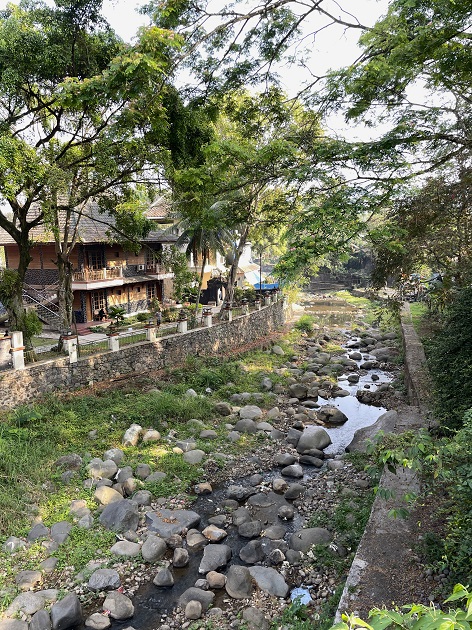

After a few days of exploration in West Java, I called a taxi and headed to the course location, which was in a hotel next to the rushing Cisadane River.
During registration, I slowly acknowledged my current reality and observed the people I would spend the next 12 days with.. in noble silence. (Oh yeah, the net 10 days of the course is a gross 12, including the check-in and check-out.) Honestly, I wasn’t particularly interested in anyone, and it was never a problem for me to go days without talking to people. Based on this, I was kinda happy to skip the awkward daily small talk.
There were fewer of us in this group than the capacity, which was fortunate coz I got a private room. (You usually share a room with someone.) I felt supported by the Universe (or call it whatever you want) to give me the comfort to do what I had to do after I had already decided to do it. And there were days when I felt overly grateful because I needed this space to go through my processes. On every even day (such a weird pattern), I died a little, and either the purification or the breakthrough came.
The 10-day Vipassana course has a very fixed schedule, and after a few days, you will certainly understand why and why it is necessary. Wake up gong at 4 am, meditation starts at 4:30, breakfast at 6, then more meditation. 11:30 am lunch and siesta, then long meditations until 7 pm. Finally, evening discourses that I really enjoyed. We watched recordings of S.N. Goenka talking about the meditation technique, coloured with stories (he was a funny and great storyteller). Interestingly, almost every evening, I also heard the answers to my unasked questions that arose that day, and the talks puzzled the coherent picture of what was happening.
On day 1, I honestly questioned how the hell I was going to make it through these 10 days. I’m not a morning person, the end of the course seemed so far away, meditating – or at least trying to – and sitting for 10 hours every day.. well, it didn’t sound very appealing. But the meditation technique is well structured and builds up with each day. You take it step by step to reach the final form of the practice. The first three days are the preparation, then the real deal happens on the fourth day. If you make it this far (some people disappeared, even tho you have to commit to staying for the full length), it gets easier, and you just go with it till the end.
In regards to my personal experience: it was tough. On the physical level, sitting on the floor was not compatible with my body, so when my neck started cracking on day 3, I requested to sit on a chair instead (luckily, there’s a little flexibility in this, and I wasn’t the only one choosing a more comfortable position). The floor cushions were also amusing to watch from the back row. The large and small pillows changed shape every day. Towards the end of the retreat, they grew into huge piles and interesting formations (some people basically built armchairs out of pillows). Each person’s meditation ground was like an individual tower of Babylon.
On the mental level, it’s more abstract. I felt everything and nothing. I felt that all the stuff I had been working on, the last remaining pieces, had been cleared out. Sometimes, I also had physical symptoms.. sobbing, hyperventilation, unstoppable coughing, shaking, muscle spasms. But I understood and accepted what was happening, so I just let it happen and let the shit go. Release and relief. I couldn’t imagine that meditation could have such effects, and it became clear why other forms of meditation are useless.
In Vipassana, there’s no music, talk, or visualization (just an initial chanting). It’s purely you, your breath, and your mind. Nothing else. And that is exactly what I can accept, what actually works for me. A technique without any frills, which only distracts but cannot reach the root and address the real problems. I find this pure form beautiful. Simple as it is.
A word about the chanting tho. I don’t get it. Each meditation session began and ended with the chanting of Goenka. But anyone with ears could hear that his singing was terrible. It wasn’t so bad that you got psychosis, but it was irritating enough to notice. Then, on the fifth day, I had an epiphany that he was doing this on purpose. Thus, he trains you how to ignore or react to the unpleasant things in everyday life. I don’t know the truth, but in my case, he did the job. After this point, I just ignored the scratching in my ear and told myself that this would also pass. Anicca.
Despite all the mental and physical struggles, we were treated very well. The bed was pretty comfortable, and the meals, OH MY GOD, were delicious. I heard that the food in these courses is very plain and not too tasty. Well, those people must not have taken a course in Indonesia. Breakfast and lunch (no dinner) were flavorful and various vegetarian heaven. Definitely the highlights of the day.
From day 7, I could see the end, and inspirations, ideas, and plans started popping up in my mind. I really enjoyed these insights (they were like a fresh breeze) and couldn’t wait to get back to my little life. The last day of the course is about noble speech. I felt a bit uncomfortable and kept my distance for a few hours. The noise was overwhelming, and I didn’t understand how people could switch so quickly and go into full speech in seconds.. and how much they had to say. Then I blended in, had a few nice convos, and my worry jumped to check-out day when I had to face the Indonesian reality again. Back to civilization on a Sunday morning – with all the traffic, noise, smells, and gosh, people. I’ve lived here long enough to handle it, but you never know.
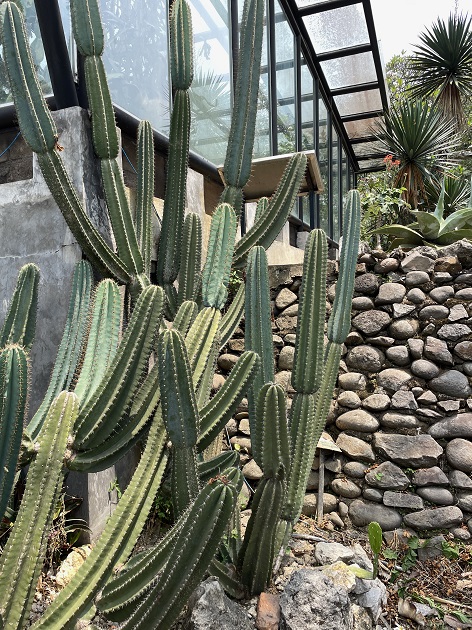
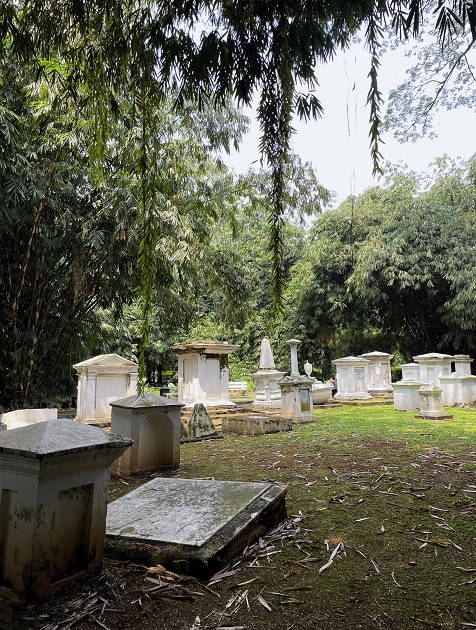
After saying goodbye to the ‘lockdown’, I headed to Bogor City, grabbed a good cappuccino, and walked to the botanical garden. It was too hot, I was too exhausted, and I also noticed some edginess in my communication – not because I was in a bad mood or wanted to be rude, it just didn’t flow after 12 days of separateness. Bogor Botanical Gardens is a must-visit spot with thematical gardens, a Dutch cemetery, a bamboo forest, and a zoology museum. It’s expansive, and although usually packed with people, you can still find a quiet spot.
The conclusion:
Vipassana is about voluntarily going to prison to free yourself. I would make it mandatory for every human being to attend a 10-day course at least once in their lifetime – preferably at a young age. We would have way less assholes, dramas, and conflicts.
I won’t lie, I haven’t meditated one hour in the morning and one hour in the evening since I left. (I’m also glad the chanting didn’t stick in my mind.) Maintaining the practice in your routine life is much more challenging than in a set environment – it requires a huge commitment, which I don’t have at this point. But I learned a lot. I gained essential knowledge and a tool to calm my mind whenever needed. I also achieved why I ultimately came here: I generally have a big mouth and use big words while only hovering on the surface and not diving deep. What happens now is that I do duck dives and see what it feels like, how deep I can go, and realize with joy that I like it down there.
 The Flux in PARADISE
Comment