I love riding motorbikes in Bali. Maybe it’s just the magic of newness, but it feels so natural and free. Of course, the rules and practices are different everywhere, and this island has its own characteristics, too.
MY PERSONAL STORY
I’ve been a passenger on a scooter countless times, but I haven’t driven it.. until now. Although I knew there was no other way to go around the island, I obviously had some doubts, and sitting behind taxi drivers didn’t build my courage either. When I visited Nusa Penida, the time came. Distances are enormous, and I didn’t want to book an organized tour or pay for a private driver. I need my own freedom and timetable, so I rented a scooter (whatever happens, happens). If you’ve been to Penida, know exactly what I mean by awful roads – mostly just paths or some thrown-together asphalt with huge holes everywhere (of course, these no-roads lead to the most magical places). I was cruising with my overused scooter for two days all around the island, and if I could drive here, I can drive anywhere. It was like being cast into deep waters, but I’m happy that I took the leap because it gave me the boost to continue.
After this, driving in North Bali felt like heaven. I had my first local traffic experience in Amlapura and my first good bike in Singaraja – OMG, that feeling when your ass doesn’t hurt from diving, and the ride feels like drifting on clouds. Singaraja is an authentic local town where I learned a lot about navigation, stop-and-go, managing road trips, and I also got used to the proximity of all kinds of vehicles and the constant exhaust fumes.
The beauty of Bali traffic is that every district has its own vibe and traffic style. I really enjoy how the flow changes from one area to another, and I try to find the perfect mix of my European car driving experience and my 100% Bali scooter style. As I see it, if you have zero background in driving, it’s much easier to learn and adapt to the local rules.
SAFETY FIRST
It doesn’t matter if you lack practice or drive slowly; no one cares. What matters is being confident and fully aware. There’s no time for daydreaming, anything can happen anytime; be responsible for yourself and others. It’s better to be a slow snail than a flat frog.
Therefore, always wear a helmet! I know it’s more awesome to be free and feel free, but wearing a helmet not only keeps the police fines but pigeons in your face away.
The roads in Bali are mostly okay but can be tricky; ups and downs, hairpin turns, gravel, and different shapes and sizes of holes make it exciting (especially during and after rain). You also share the road with all kinds of animals (people, chickens, dogs, cows), and they claim priority for themselves. So, even if you’re a pro, there are situations when it’s wise to go slower.
And altogether, do not drive if..
- you are scared,
- you get easily angry or offended,
- and when you are drunk or high!
These are very simple rules, particularly the last one, yet so hard to understand for many. Be the difference!
THE LOCAL DRIVERS
How do they drive? A picture is worth a thousand words:
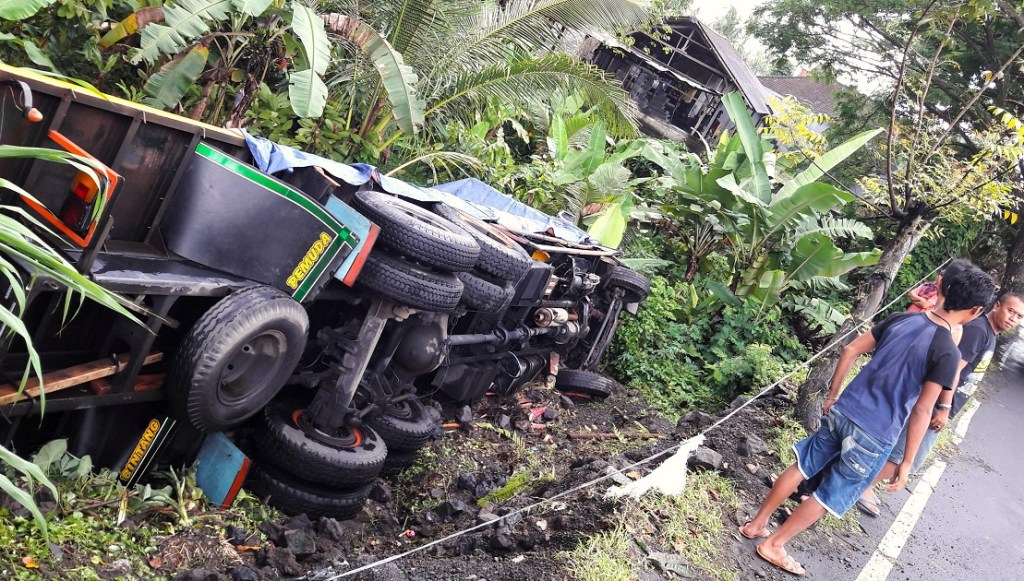
Sure, good drivers are everywhere, but the majority just survive on the roads. As my Western eyes see it, the main problem is not the character of the traffic; it’s more that..
- they lack depth perception,
- they cannot feel the edges of the vehicles,
- they don’t use the mirror (only to check make-up and pimples),
- they are constantly on their mobiles,
- and they believe that others are paying attention.
Well.. their religion is strong, but a falling vehicle is stronger.
In Asia, the rules are different, and to an outsider, organized chaos looks just like chaos. If you think you will drive on the side of the road at your own tempo, and it will be fine.. don’t! The side is more dangerous than slaloming between cars in the middle. Simply because..
- they don’t really use the indicators (and usually forget to turn it off),
- they stop in front of you without any warning,
- they enter the road without looking around,
- and they love to drive against the traffic (just because it’s shorter).
Car drivers are slightly different, but many times, it seems the driver doesn’t realize that he’s sitting in a car and not on a bike. Cars are also status symbols, and people buy bigger and bigger cars.. only the dimensions of the roads remain the same. Of course, they are afraid of their precious belonging, and because of the lack of proprioception, they drive in the middle of the road instead of their lane. As a result, the general rules of overtaking are entirely useless – you overtake when and as you can.
BASIC AND VERY SIMPLE RULES
- Left-hand traffic (except for the side of the road).
- Lines, signs, and traffic lights are just for your kind information (except on main roads).
- You can turn left literally anytime, anywhere.
- Horns mean many things. It can be ‘notice me’ or ‘get out of my way’ (many horns mean ‘wtf are you doing’) or just greeting the gods (when passing by temples).
- And the most important rule: what is in front of you is your responsibility. Generally speaking, they drive accordingly – what is behind them is not their problem (this is like a life philosophy in practice). Honestly, I don’t use the mirror that much either; I drive more and more with my ears – however, mirrors are essential on the highway if you don’t want to die.
ACCIDENTS
There are two kinds of people: those who have fallen already and those who haven’t yet. To clarify, no one wants to kill you (most probably). They want to take your money and might steal from you, but no one wants to take your life.. that’s no good business. The most typical recipe for an accident is a drunk tourist on two wheels. Too much drama, panic, and irresponsible behavior. So please do yourself (and others) a favour, and..
- do not drive when you are drunk or high,
- do not hold the phone (or any valuable) in your hand,
- do not be arrogant,
- and at least try not to act like a victim.
PRO TIPS
If you want to be a better driver than the average:
- be fully conscious and visible,
- widen your periphery (use the mirrors and watch the road),
- overtake when it’s safe, not when you are pissed off,
- always hold the steering wheel (especially on highways and when speeding),
- wear face masks and sunglasses (too much exhaust fumes, gravel, and insects in the air),
- wear shoes, or at least flip-flops (driving barefoot is gross and stupid),
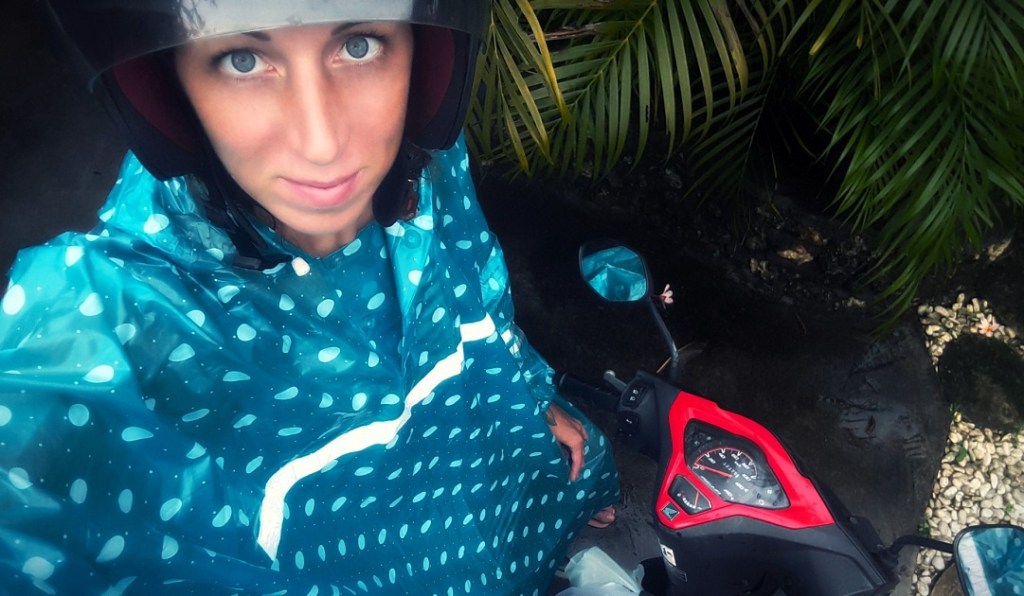
- and always have a poncho with you (it’s the most essential accessory).
RENTING A SCOOTER
Rentals are everywhere, but to avoid unnecessary scams, it’s smarter to rent from your accommodation or after a recommendation.
Daily prices depend on the area, the size, and the condition of the scooter. If you rent for more days, you can negotiate a better price. Long-term rentals are actually the best; in this case, it’s really important to rent from the right guy.
I recommend choosing a scooter that suits your body proportions (consider the brand, type, and CC). Helmets usually come with it, but always check that they fit, too. If you stay longer, buy your own helmet – it’s inexpensive and elevates the comfort and driving experience.
They say scooters do not have insurance in Bali. The fact is if the owner pays the yearly taxes properly, then it is insured. This is a good scam opportunity, so they can make you pay if something happens. Minor scratches and damages are everyday occurrences, but an accident or loss of the bike is another story. Again, rent from the good guy.
Different bikes mean different personalities (just like whether you are a BMW or Mercedes person). I won’t go into deep analysis; what matters is that new bikes are always better because the chassis suffers a lot on the roads, and maintenance is not in the vocabulary here.
The fuel is super cheap, and you have different options to fill the tank:
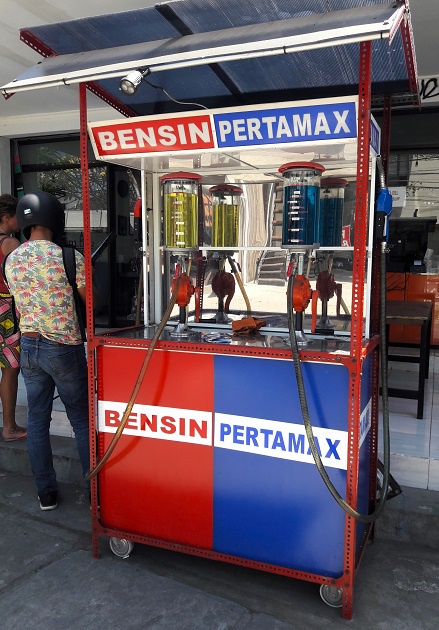
- Pertamina: the national oil and gas company that owns all petrol stations. There are usually dedicated lines for scooters, and refueling is quick and easy: when it’s your turn, remove the gas cap, an attendant fills the petrol, you hand over the money, and done (quite efficient, literally takes 2 minutes). There are two types of fuel: Pertamax and Pertalite. Of course, there’s a difference in composition, but Pertalite is cheaper and works perfectly well for motorbikes.
- Pertamini: mobile stations operated by small shops. The price is variable and a bit more expensive than the main station.
- Anyway, no matter what happens on the way, fuel is the last thing you have to worry about. You can find petrol served in bottles even in the middle of nowhere. Petrol is life, and locals are ready to help you in need.
DRIVING LICENSE
Officially, every foreigner in Indonesia needs an international driving license. Unofficially, you can drive without it, just have some cash in your pocket (if you know what I mean).
Out of tourist areas, police control is rare, but it still can happen (it’s helpful to know the fixed checkpoints, then you can find shortcuts). I don’t encourage you to go illegal, but if they want to fine you, they will find a reason – don’t talk, give the money, and you are free to go (you spare yourself some time and unnecessary stress).
If you don’t have an international license but want to assure yourself, you can obtain an Indonesian driving license for tourists. This does not make sense for the short term and if you only drive a scooter. However, it offers a good solution for the long term.
An international license has a lot of benefits:
- you can rent and drive a car,
- you can bring the scooter out of the island (like crossing to Lombok),
- accidents are covered by your travel insurance (without a license, you must pay for everything yourself).
Bali is beautiful, and it would be a huge mistake not to explore it. Besides the freedom, you can find incredible places with a scooter that you would completely miss on an organized tour. Enjoy the ride!
 The Flux in PARADISE
Comment